Camino Sanabres Guide: Stages, Hostels & Costs
The Camino Sanabres is a historic route of the Camino de Santiago, one of the worlds most popular ancient Christian pilgrimage trails. The Camino Sanabres is only 234 mi (378 km) long, and it takes only 2 weeks to complete. I hiked it and here´s why you should do it, too.
THIS POST MAY CONTAIN COMPENSATED LINKS. PLEASE READ MY DISCLAIMER FOR MORE INFO.
What is the Camino Sanabres
The Camino Sanabres, or the Sanabrese Way, is an 800-year-old Camino de Santiago route in Spain.
The Camino Sanabres is a Camino de Santiago route by itself. But it also serves as a branch of the Via de la Plata route. Camino de Santiago Via de la Plata route (that begins in Seville and ends in Santiago) forks after Salamanca in the Zamora province to two sub-routes: Via de la Plata Camino Sanabres (via Ourense) and Via de la Plata Galician variant (via Astorga).
The Camino Sanabres acts as a branch of the Camino Via de la Plata. The Camino Via de la Plata Camino Sanabres goes through the city of Ourense to Santiago de Compostela. That’s why Camino Sanabres is also called Via de la Plata Ourense.
Camino Sanabres is the longest Jacobean route of Galicia. Even 124 mi (200 km) of Camino Sanabres goes through Galicia (from A Gudina to Santiago de Compostela).
Several hundred years ago, merchants and farmers from Galicia used the Camino Sanabres on their way to Castilla y Leon during the harvesting season. The Camino Sanabres was one of the so-called ‘veredas’ transit routes from Galicia to Castilla and Leon.
In the Middle Ages, Christian pilgrims started using the Camino Sanabres as a pilgrimage path on their way to Santiago de Compostela.
Where is Camino Sanabres
The Camino Sanabres connects two regions of Spain: Castilla y Leon and Galicia.
The Camino Sanabres goes from Granja de Moreruela in Castilla y Leon through an area called Sanabria and the city of Ourense towards Santiago de Compostela in Galicia.
The Camino Sanabres is named after Sanabria. Sanabria is an area and a county in Zamora province, known for Sanabria Lake Nature Reserve (318 ha of land of mountains and impressive Sanabria glacier lake) and the medieval town of Puebla de Sanabria.
Where does the Camino Sanabres begin?
The Camino Sanabres begins in Granja de Moreruela, a tiny village in Zamora province in Castilla y Leon.
Granja de Moreruela is located about 18 mi (30 km) north of Zamora and 62 mi (100 km) north of Salamanca. It is also 162 mi (260 km) northwest of Madrid.
Pilgrims usually begin walking the Camino Sanabres in Granja de Moreruela and hike the entire route of 234 mi (378 km) from Granja de Moreruela to Santiago de Compostela.
Some pilgrims start the Camino in Ourense and walk the last 62 mi (100 km) from Ourense to Santiago de Compostela to obtain their Compostela, as walking at least the last 62 mi (100 km) is mandatory for obtaining a Compostela certificate.

How to get to Granja de Moreruela?
Granja de Moreruela is located in Zamora province. The nearest town to Granja Moreruela is Zamora.
Granja de Morerula is 30 minutes by bus from Zamora (and Zamora is only 1 hour by train from Madrid). Granja de Moreruela is 5 hours by bus from Madrid.
Granja de Moreruela is also 1 hour and 20 minutes by bus from Salamanca.
How to get to Oursense?
The city of Ourense is easily reachable from Santiago, A Coruna, and Madrid by train.
It takes only 35 minutes by train from Santiago to Ourense, 1 hour by train from A Coruna to Ourense, and 2 hours and 15 minutes by train from Madrid to Ourense.
How long is the Camino Sanabres?
The Sanabres Way is a mid-length Camino de Santiago route, just like the Camino Primitivo (Camino de Santiago Primitive Way).
The Camino Sanabres is 234 mi (378 km) long. It has 13 walking stages (etapas) in total.
It means that the entire Camino Sanabres route can be hiked in about 14 days (2 weeks).
Why hike the Camino Sanabres?
The Camino Sanabres uses ancient Roman roads that go through the unspoiled nature of Castilla y Leon and Galicia.
The Sanabres Way of Camino de Santiago is one of the least-traveled Camino de Santiago routes. It is recommended for pilgrims who enjoy serenity, peacefulness, and beautiful natural landscapes.
The Camino de Santiago is also for people who have only 2 weeks available but wish to walk the Camino de Santiago.
Camino Sanabres stages (Camino Sanabres etapas)
Stage 1: Granja de Moreruela – Tabara (15 mi; 25 km)
Granja de Moreruela – Faramontanos de Tábara (18 km) – Tábara (25 km)
The Camino Sanabres begins in Granja de Moreurela in Zamora province in Castilla y Leon. The first stage is 16 mi (25 km) long.
The first stage of Camino Sanabres goes from Granja de Moreurela and the elegant Quintos bridge over the river Esla to the villages of Faramontanos de Tabara and Tábara with the Sierra de la Culebra mountain range in the background.
The most impressive site of this stage is Moreruela Abbey, a former Cistercian monastery from the 9th century on the outskirts of Granja de Moreruela. The monastery is the first Cistercian monastery on the Iberian Peninsula, and today it is a Spanish national monument.
Tábara is the end of the first stage of Camino Sanabres. Pilgrims’ hostel in Tabara (Albergue de peregrinos de Tabara) is one of the most iconic albergues on Camino Sanabres for the hospitality of its hospitaleiro.

Stage 2: Tábara – Santa Marta de Tera (14.2 mi; 22.9 km)
Tabara – Bercianos de Velverde (14.5 km) – Santa Croya de Tera 821 km) – Santa Marta de Tera (22.9 km)
The second stage of Camino Sanabres goes from Tábara to Santa Marta de Tera. The second stage is 14.2 mi (23 km) long.
The village of Santa Marta de Tera keeps the oldest known statue of St James, the Apostle, portrayed as a pilgrim with a scallop shell on his pouch.
The statue of St James the Pilgrim dates back to the 12th century. It hangs on the backside of the church of Santa Marta de Tera, the oldest Romanesque church in Zamora province.
Today, the St James statue from Santa Marta de Tera is the symbol of Camino Sanabres. There are many waymarkers with the statue of St James the Pilgrim along the Camino Sanabres route.

Stage 3: Santa Marta de Tera – Mombuey (22.4 mi; 36.1 km)
Santa Marta de Tera – Camarzana de Tera (4.8 km) – Calzadilla de Tera (11 km) – Olleros de tera (13 km) – Villar de Farfon (21 km) – Rionegro del Puente (27 km) – Mombeuy (36.1 km)
The third stage of Camino Sanabres is long. It covers 24.4 mi (36.1 km) from Santa Marta de Tera to Mombeuy.
In the first part of the third stage, the Camino follows the Tera River. It continues to the dam of Nuestra Señora del Agavanzal (Reservoir of Our Lady of Agavanzal) and the village of Villar de Farfón with San Pedro church.
Climbing the bell tower of San Pedro church in Villar de Farfón provides stunning views of the lake, dam, and village.
In this stage, the Camino Sanabres route goes to the village of Rionegro del Puente, where many pilgrims choose to stay overnight and shorter this stage, instead of proceeding to Mombuey.
You can choose to stay in Rionegro del Puente and hike 16 mi (27 km) on the third day (instead of 36 km to Mombeuy), too.
However, the bell tower of the Iglesia de la Asuncion in Mombuey is a must-see monument on Camino Sanabres. Templar Knights built it in the 13th century. So, don’t miss out on seeing it!
On the third day of my Camino Sanabres walk, I decided to hike from Santa Marta de Tera and Rionegro del Puente. I walked 16 mi (27 km) on my third day of Camino de Santiago Sanabres.

Stage 4: Mombuey – Puebla de Sanabria (19.7 mi; 31.7 km)
Mombuey – Valdemerilla (5 km) – Cernadilla (8.5 km) – San Salvador de Palazuelo (10.4 km) – Entreppenas (14 km) – Asturianos (17 km) – Palacios de Sanaría ( 20.5 km) – Remésalo (22.5 km) – Otero de Sanaría 825 km) – Triufe (28 km) – Puebla de Sanabria (31.7 km)
The fourth stage of Camino Sanabres is again one of the longest stages. It covers 20 mi (32 km) in total.
The stage goes through several smaller villages and utilizes a mix of roads and dirt tracks. The beautiful town of Puebla de Sanabria marks the end of this long stage. Because of the length of this stage, many pilgrims opt to stay in Asturianos to reach Puebla de Sanabria the next day. I did the same on my Camino Sanabres hike.
On the fourth day, I hiked 16 mi (26 km) from Rio Negro del Puente to Asturianos.
Asturianos is a lovely village with all services, a lovely chapel of the Virgen del Carmen, and a welcoming pilgrims’ hostel. So, if you want to shorten this stage, stay in Asturianos and head to Puebla de Sanabria refreshed the next morning. It takes only 9.6 mi (15 km) from Asturianos to Puebla de Sanabria.
Puebla de Sanabria is one of the most beautiful places in Spain.
This gorgeous town is known as one of the ‘Los pueblos mas bonitos de España‘.
It is a picturesque medieval town known for the 15th-century Castle of Benavente Counts, the 13th-century Nuestra Señora de Azogue church, the San Carlos fort, and the 17th-century San Cayetano hermitage.
Puebla de Sanabria is declared a national cultural and artistic site in Spain.

Stage 5: Puebla de Sanabria – Lubian (18.4 mi; 29.6 km)
Puebla de Sanabria – Terroso (10 km) – Requejo (13 km) – Padornelo (24 km) – Aciberos (28 km) – Lubian (29.6 km)
The fifth stage of Camino Sanabres goes from Puebla de Sanabria to Lubian. It is again a long stage covering 18.5 mi (30 km) in total.
This stage comes with beautiful landscapes. It goes along a river, meadows, chestnut trees, and oak forests.
But, the Camino Sanabres pilgrims usually choose to walk only 15 km from Asturianos to Puebla de Sanabria to have a full day in Puebla de Sanabria.
After all, magical Puebla de Sanabria has much to offer!
If you decide to do the same, you can walk from Puebla de Sanabria to A Gudina the next day. The next stage from Puebla de Sanabria to A Gudina will be a long one, but after walking only 15 km the previous day, you have the strength to do it.

Stage 6. Lubian – A Gudina (14.7 mi; 23.7 km)
Lubian – A Canada (7.5 km) – A Vivalella (11 km) – O Pereiro (15 km) – O Canizo (28 km) – A Gudina (23.7 km)
This Camino Sanabres stage covers 14.7 mi (23.7 km) in total.
The Camino enters Galicia at this stage.
The route of this stage goes through lots of greenery, but you can expect to encounter lots of rain. This stage is particularly known for rainfall.
However, the Camino path follows the Tuela River, passes by the 18th-century chapel of Tuiza, leaves Castilla y Leon, and finally enters Galicia.
The churches of San Martín and San Pedro in A Gudina are must-sees.
A Gudina, also spelled La Gudina, is a small village with arguably the best municipal hostel for pilgrims not only on Camino Sanabres but on all Camino de Santiago routes.
In A Gudina, the route branches to Laza and Verin. Verin is a longer branch than Laza, but the Verin variant is recommended for cyclists as it follows the asphalt. The branches rejoin in the city of Ourense.

Stage 7: A Gudina – Laza (21.4 mi; 34.5 km)
A Gudina – Campobecerros (20 km) – Portocamba (23 km) – As Eiras (28 km) – Laza (34.5 km)
This stage is one of the longest and most scenic Camino Sanabres stages.
The trail goes at a thousand meters of altitude with sweeping views. The landscapes of this Camino Sanabres stage are breathtakingly stunning.
The route goes next to Embalse de As Portas reservoir, a large inland sea that will take your breath away. The route follows mostly dirt tracks. So, in spite of the length, this stage is easy to hike.

Stage 8: Laza – Xunqueira de Ambia (20.5 mi; 33 km)
Laza – Soutelo Verde (3.3 km) – Tamícelas (6.2 km) – Albergueria (12 km) – Vilar de Barrio (19 km) – Vilar de Gomareite (22 km) – Bobadela a Pinta (28 km)- Cima de Vila (30 km) – Xunqueira de Ambia (33 km)
This stage is not long, but it is one of the most difficult stages of Camino Sanabres. The route goes uphill, and the climb is steep.
The village of Albergueria is at the top of a hill. Albergueria has a unique pilgrims hostel and a coffee bar decorated with scallop shells. Albergueria is a must-stop on the route, for a refreshing drink in the bar or a stay in the most unusual Albergue ever.
After Albergueria, the Camino continues through the mountains to the village of Vilar do Barrio, where you can stay in Albergue as well ( in case you choose to continue your hike that day, but you want to shorten this stage).
The challenging hike from Laza to Vilar do Barrio is 12.8 mi (20 km) long.

Stage 9: Xunqueira de Ambia – Ourense (13.5 mi; 21.8 km)
Xunqueira de Ambia – A Pousa (3.2 km) – A Chouzana (5 km) – Ousende (5 km) – Ousende (7.4 km) – Pereiras (11 km) – Castellana (13 km9 – A Zamorana (14 km) – rebordeo (15 km) – Seixalbo (18 km) – Ourense (22 km)
This is a short and easy stage.
Ourense is a wonderful city famous for its thermal baths and beautiful Cathedral.
There are many things to do in the city of Ourense: from relaxing in ancient Roman thermal baths to sightseeing churches in Ourense to exploring fabulous Spanish tapas bars (especially, ‘pulperias’ – traditional taverns selling octopus dishes).
Sunday is traditionally a ‘pulpo’ day in Ourense. Delicious pulpo alla gallega (the Galician-style octopus) is traditionally sold on the street stalls in Ourense.
It is a special treat for seafood lovers to be in Ourense on Sundays. In case you are not familiar with it, the Galician-style octopus is one of the most popular Spanish dishes.
If you start walking this stage in Xunqueira de Ambia early in the morning, you will reach Ourense around noon and have enough time to enjoy this beautiful Galician city.

Stage 10: Ourense – Cea (13.1 mi; 21.2 km)
Ourense – Cudeiro (4 km) – Tamallancos ( 12.5 km) – Bouzas ( 13.5 km) – Sobreira (16 km) – Faramontaos ( 17 km) -Viduedo (19 km) – Payos (19.6 km) – Casas Novas (20.7 km) – Cea (22 km)
This is a relatively short stage, but you can extend it and go to Oseira Monastery.
Santa Maria de Oseira Monastery in Galicia is a must-see on the Camino de Santiago, the Camino Sanabres. This monumental monastery is nicknamed the Galician Escorial.
Oseira Monastery is an 8 km detour from Cea. It has a wonderful pilgrims’ Albergue. The hostel is run by Xunta Galicia, and it is adjacent to the monastery.

Stage 11: Cea – A Laxe (19 mi; 32 km)
Cea – Pielos (6 km) – Oseira (8,6 km) – A Gouxa (15 km) – Castro de Dozon (20 km) – A Laxe (32 km)
This is a long but easy stage as it goes mostly downhill.
But, if you walk to the Oseira Monastery on the previous day, this stage can be much shorter. There are only 18.3 mi (29 km) from Oseira to Laxe. I slept in Albergue del Monasterio de Oseira and hiked to Laxe the next day.
In any case, this stage takes some truly beautiful paths amid the greenery.


Stage 12: A Laxe – O Outeiro (20 mi; 33.5 km)
A Laxe – Bendoiro de Abaixo (1.3 km) – A Ponte Taboada (5 km) – Transfontao (7.5 km) – Silleda (10 km) – Riocalvo 12.8 km) – Bandeira (16.3 km) – Dornelas (21.4 km) – San Miguel de castro (27.3 km) – Ponte Ulla (29.3 km) – O Outeiro (33.5 km)
This stage is one of the longer stages again.
Many pilgrims shorten it by staying in Ponte Ulla, instead of going to O Outeiro. The distance between A Laxe and Ponte Ulla is 18.3 mi (29 km).
Ponte Ulla is a good place to end the stage since it has bars, restaurants, and grocery shops. Unlike O Outeiro, where there are no services.
If you decide to sleep in Ponte Ulla, you will hike the last 12 mi (20.5 km) to Santiago de Compostela the next day.
This is exactly what I did. Ponte Ulla was my last overnight stop on Camino Sanabres.

Stage 14: Outeiro – Santiago de Compostela (10.4 mi; 16.7 km)
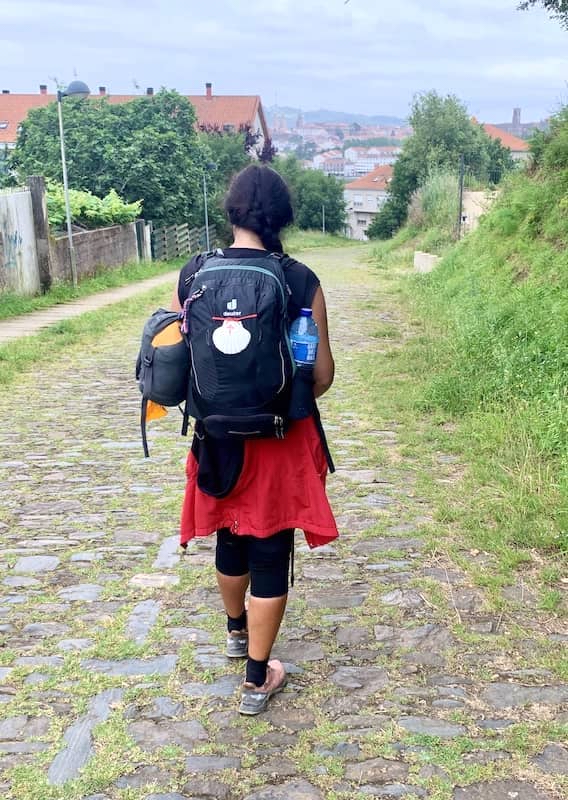
O Outeiro – Lestedo (3.4 km) – Deseiro (6 km) – Susana (7.2 km) – Pineiro (12 km) – Santiago de Comspotela (16.7 km)
This stage is short for a reason.
If you start this stage in O Outeiro around 8 am, you will reach Santiago around noon.
As you might already know, the pilgrim’s mass in the Cathedral of Santiago starts at noon. So, this short stage is for the pilgrims who wish to get up earlier in the morning and reach the pilgrim’s mass on time.
If you sleep in Ponte Ulla on the previous day, you will need to start hiking earlier in the morning to arrive at the mass on time.
But even if you don’t make it on time, don’t worry. The evening pilgrims’ mass is at 7.30 pm every day.

The Camino Sanabres etapas – summary
| Starting Point | Finishing Point | Distance (mi) | Distance (km) | Duration (hours) | Difficulty (1 very easy … 6 very difficult) | |
| Stage 1 | Granja de Moreruela | Tabara | 15 mi | 25.1 km | 6 h 15 min | Easy (2 out of 5) |
| Stage 2 | Tabara | Santa Marta de Tera | 14.2 mi | 22.9 km | 5 h 45 min | Easy (2 out of 5) |
| Stage 3 | Santa Marta de Tera | Mombuey | 22.4 mi | 36.1 km | 9 h | Difficult (4 out of 5) |
| Stage 4 | Mombuey | Puebla de Sanabria | 19.7 mi | 31.7 km | 8 h | Moderate (3 out of 5) |
| Stage 5 | Puebla de Sanabria | Lubian | 18.4 mi | 29.6 km | 7 h 30 min | Difficult (4 out of 5) |
| Stage 6 | Lubian | A Gudina | 14.7 mi | 23.7 km | 6 h | Moderate (3 out of 5) |
| Stage 7 | A Gudina | Laza | 21.4 mi | 34.4 km | 8 h 30 min | Difficult (4 out of 5) |
| Stage 8 | Laza | Xunqueira de Ambia | 20.5 mi | 33.0 km | 8 h 30 min | Difficult (4 out of 5) |
| Stage 9 | Xunqueira de Ambia | Ourense | 13.5 mi | 21.8 km | 5 h 30 min | Very Easy (1 out of 5) |
| Stage 10 | Ourense | Cea | 13.1 mi | 21.2 km | 5 h 15 min | Moderate (3 out of 5) |
| Stage 11 | Cea | A Laxe | 19 mi | 32 km | 8 h | Easy (2 out of 5) |
| Stage 12 | A Laxe | Outeiro | 20 mi | 33.6 km | 8 h 15 min | Moderate (3 out of 5) |
| Stage 13 | Outeiro | Santiago de Compostela | 10.4 mi | 16.7 km | 4 h | Very Easy (1 out of 5) |
Camino Sanabres Accommodation
| Stage | Stage | Place (village -town) to sleep | Albergue | Hotel |
| Granja de Moreruela | Granja de Moreruela | Albergue de peregrinos de Granja Moreruela (6 €; | ||
| Stage 1 | Granja de Moreruela – Tabara | Tabara | Albergue de peregrinos de Tábara (Donation; address:Camino Sotillo, s/n) | El Roble Hotel (check out Booking.com ) |
| Stage 2 | Tabara – Santa Marta de Tera | Santa Marta de Tera | Albergue de peregrinos de Santa Marta de Tera (5 €, address: C. de la Iglesia, 10) | |
| Stage 3 | Santa Marta de Tera – Mombuey | Mombeuy | Albergue de peregrinos de Mombuey (Donation: address: C. de la Iglesia, s/n) | Hotel La Ruta ( www.hotellaruta.com ) |
| Stage 4 | Mombuey – Puebla de Sanabria | Puebla de Sanabria | Albergue Casa Luz ( 12 €, address: C. Padre Vicente Salgado, 14 ) | Hotel Los Perales ( check out Booking.com ) |
| Stage 5 | Puebla de Sanabria – Lubian | Lubian | Albergue de peregrinos de Lubián ( 5 €, address: C. de la Cruz, s/n ) | Casa Mariana (check out Booking.com) |
| Stage 6 | Lubian – A Gudina | A Gudina | Albergue de peregrinos de A Gudiña ( 8 €; Rúa Beato Sebastián de Aparicio, s/n ) | HOTEL BRUMA II ( check out Booking ) |
| Stage 7 | A Gudina – Laza | Laza | Albergue de peregrinos de Laza ( 8 €; address: Rúa do Toural, s/n ) | El Camino (check out Booking.com ) |
| Stage 8 | Laza – Xunqueira de Ambia | Junqueira de Ambia | Albergue de peregrinos de Xunqueira de Ambía ( 8 €; address: C. Asdrúbal Ferreiro, s/n) | Vivienda de uso turístico Xunqueira De Ambía (check out Booking.com ) |
| Stage 9 | Xunqueira de Ambia – Ourense | Ourense | Albergue de peregrinos de Ourense (8 €; address: Rúa da Barreira, 12 ) | Hotel Novo Cándido (check out Booking.com ) |
| Stage 10 | Ourense – Cea | Cea | Albergue de peregrinos de Cea (8 €; address: C. Santo Cristo, 5 ) | Casa Mañoso (check out Booking.com ) |
| Stage 11 | Cea – A Laza | O Castro ( A Laza) | Albergue de peregrinos de Castro Dozón ( 6 €; address: Ctra. N-525, s/n ) | |
| Stage 12 | A Laza – Outeiro | Outeiro | Albergue de peregrinos de Outeiro ( 8 €; address: Outeiro, s/n ) | |
| Stage 13 | Outeiro – Santiago de Compostela | Santiago de Compostela | Albergue Seminario Menor (check out Booking.com ) |
Waymarkers on the Camino Sanabres
Camino Sanabres has some of the most unique and finest Camino waymarkers of all Camino de Santiago routes.
Along with standard Camino signposting, Nicanor Arballo, a sculptor from Ourense, carved some extraordinary stone (and pilar) waymarkers.


The Camino Sanabres Packing List
I’ve packed the very same items first for the Camino del Norte in the summer of 2021, and then for the Camino de Santiago Via de la Plata, Camino Sanabres, and Santiago Fisterra in June 2022.
As a light traveler who enjoys minimalism, I recommend the ultralight Camino packing list.
Frankly, there’s no need to take anything else with you but the necessary items. The Camino goes through villages, towns, and cities with shops, pharmacies… So, if you need something, you can always buy it along the route.
Be kind to your back, do yourself a favor, and don’t overpack.
And, check out my ultimate Camino de Santiago packing list!

Camaino Sanabres map

Camino Sanabres costs
A typical municipal pilgrims’ hostel costs 8€ on average.
Daily menus are available for 11€.
The price of coffee goes around 2€ (depending on the type: from café solo, café cordato, to café con leche). Washing and drying machines are available in most hostels.
A typical Spanish breakfast, including coffee and pan con tomate or tostada con mermelada y mantequilla, costs around 4€.
The price of washing is 3€ and the price of drying is 3€ as well.
When to Hike the Camino Sanabres
The best seasons to hike Camino Sanabres are spring and autumn. Some parts of Camino Sanabres in spring and autumn can be muddy, but hiking Camino Sanabres in autumn and spring is good for the pleasant air temperatures.
In summer, you can expect tremendous heat in Castilla and Leon. Winters are cold in Castilla y Leon and Galicia. Besides that, Galicia is known as one of the rainiest regions in Spain. Even in summer, you can expect to have rain in Galicia!
I hiked Camino Sanabres Camino de Santiago in June and had rainy days in Galicia.
The best months to hike Camino Sanabres are April, May, June, September, and October.
A summary of the Camino Sanabres
The Camino Sanabres summary:
Starting point: Granja de Moreruela in Castilla y Leon
Finishing point: Santiago de Compostela in Galicia
Camino Sanabres length: 234 mi (378 km)
Camino Sanabres etapas: 13 stages in total
Camino Sanabres days: 2 weeks
Camino Sanabres min/max elevation: 55 m/1356 m
Camino Sanabres elevation gain/loss: 7234 m/-7689 m
Camino Sanabres best time to go: April-June, September-October
Camino Sanabres type of pilgrims: crowds-avoiding nature lovers
Percentage of pilgrims who walk Camino Sanabres: less than 0.5%


