Pilgrimage to Santiago de Compostela: Walking the Camino del Norte
The Camino de Santiago (the Way of St James) is one of the world’s most famous Christian pilgrimage trails. I was fortunate enough to walk the Camino de Santiago twice, each time for a month.
My first Camino de Santiago was walking the Camino del Norte (the Northern Way) route. Here I have written a guide to Camino del Norte for everyone who wishes to take this amazing walk.
My Camino de Norte guide covers the Camino del Norte distance, the Camino del Norte starting place, getting the Camino del Norte passport, the Camino del Norte stages, the Camino del Norte hostels/hotels, getting the Camino del Norte certificate, Camino del Norte costs, the Camino del Norte packing, etc.

THIS POST MAY CONTAIN COMPENSATED LINKS. PLEASE READ MY DISCLAIMER FOR MORE INFO.
The Ultimate Guide to the Camino del Norte
I walked 515 mi (828 km) of Camino del Norte in the summer of 2021. And here is all you need to know about walking the Camino del Norte in Spain.
What is Camino del Norte?
The Northern Way, or Camino del Norte in Spanish, is one of the several pilgrim routes of the famous Way of St James (or Camino de Santiago in Spanish).
Camino del Norte is also one of the historic routes of Camino de Santiago, and it’s inscribed on UNESCO’s World Heritage List.
However, Camino del Norte is best known as one of the most beautiful and scenic routes of the Camino de Santiago. The Northern Way of Camino de Santiago goes across Northern Spain, popularly known as Green Spain (also the Green Coast – costa verde) for its abundance of greenery.
Camino del Norte goes through the four coastal regions of Northern Spain: the Basque Country, Cantabria, Asturias, and Galicia, following the beautiful Cantabrian coast of Northern Spain. The Camino de Norte route is also called Ruta de la Costa, or Camino de la Costa.

Northern Spain is famous for its superb natural beauty (long sandy beaches, pristine green hills, breathtaking sea cliffs), but also charming fishing villages, pretty tourist seaside towns, picturesque medieval towns, and gorgeous cities (like San Sebastian, Bilbao). It is also famous for its delicious food (fresh fish, seafood, pintxos).
Nature lovers, foodies, spiritual seekers, and solitude fans prefer hiking Camino del Norte to other Camino de Santiago routes.
Let me explain why walk el Camino del Santiago?
Why Choose the Camino del Norte?
- Camino del Norte is one of the two most beautiful Camino routes, along with Camino Primitivo.
Camiño Norte goes along the spectacular Cantabrian coast of northern Spain. However, the route doesn’t follow the coast all the time. It switches to the inland of beautiful Galicia in the final phase. - Camino del Norte is the best Camino route for foodies. The Basque and Galician cuisines are known for their delicious fish and seafood dishes. The best seafood in Spain you will find in Galicia and the Basque Country (think of fresh scallops, goose barnacles, octopus, squids, razor clams, ..). For instance, dishes like mejillones rellenos, bacalao al pil pil, txipirones en su tinta, and pulpo a la gallega from the Basque Country and Galicia are some of the tastiest and most famous Spanish dishes ever. In addition, San Sebastian in the Basque Country, with its 16 Michelin-star restaurants and famous Basque pintxos, is the food capital of Spain.
- Camino del Norte is less crowded than the more popular Camino de Frances (the French way of Camino de Santiago). Pilgrims who want to escape crowds and enjoy solitude among fabulous nature prefer the coastal Camino del Norte to the inland Camino de Frances.
- People who also seek more spiritual hikes in solitude choose Camino del Norte.
Camino del Norte Stages – summary
There are 36 stages of Camino del Norte in total.
The Camino stages, or Camino etapas, do not necessarily equal the walking days of the Camino. Some Camino stages are more challenging, and some are easier to hike. There are some days when it is possible to walk two stages in one day.
Camino del Norte, how many days? You need around 30-34 days to hike the entire route of Camino del Norte,
My friend and I hiked the entire 36 stages of Camino del Norte in only 28 days. We have hiked 18.6 mi (30 km) a day on average. We had limited time for Camino de Santiago, as my friend needed to return to her workplace in 30 days. It was challenging, but we did it! Hurrah for us!
The most comprehensive online guide to all Camino del Norte stages can be found on Gronze.com. You can find a detailed description of all Camino del Norte stages there. And not only of the Camino del Norte route but of all Camino de Santiago routes.
As you hike Camino del Norte, you will notice that hikers you meet on the way use Gronze.com.
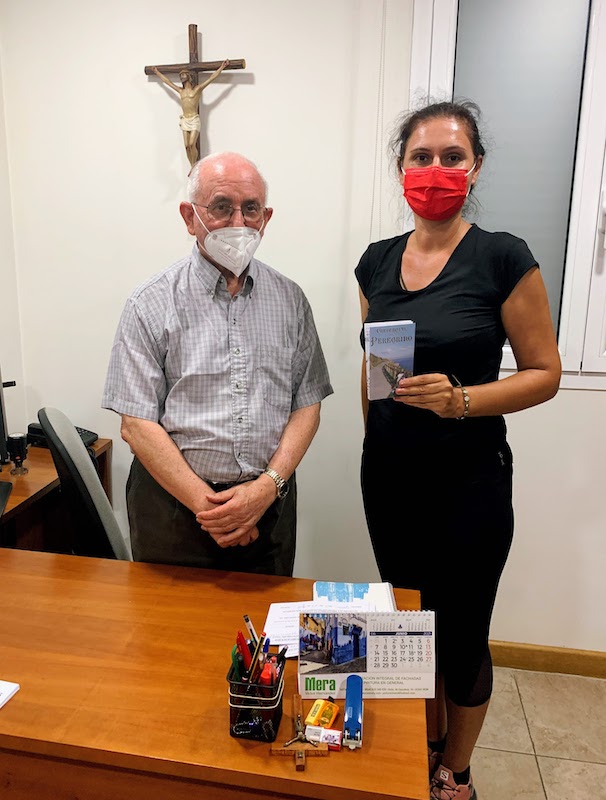
Here I want to thank the priest in Parroquia San Gabriel – Santa Gema in Irun who told us (my friend and me) about Gronze.com.
Camino del Norte Route Planner (Camino del Norte itinerary)
Camino del Norte stages
| Starting Point | Finishing Point | Distance (mi) | Distance (km) | Duration (hours) | Difficulty (1 very easy … 6 very difficult) | |
| Stage 1 | Irun | San Sebastian | 15.4 mi | 24.8 km | 6 h | Portugalete (next to the estuary) |
| Stage 2 | San Sebastian | Zarautz | 13.8 mi | 22.2 km | 5 h 30 min | Moderate (3 out of 5) |
| Stage 3 | Zarautz | Deba | 13.5 mi | 21.8 km | 5 h 30 min | Moderate (3 out of 5) |
| Stage 4 | Deba | Markina | 15.0 mi | 24 km | 6 h 15 min | Difficult (4 out of 5) |
| Stage 5 | Markina | Guernica | 15.3 mi | 24.6 km | 6 h | Moderate (3 out of 5) |
| Stage 6 | Guernica | Lezama | 12.9 mi | 20.8 km | 5 h 15 min | Moderate (3 out of 5) |
| Stage 7 | Lezama | Bilbao | 6.7 mi | 10.8 km | 2 h 45 min | Moderate (3 out of 5) |
| Stage 8 | Bilbao | Portugalete (next to estuary) | 8.3 mi | 13.3 km | 3 h 15 min | Very easy (1 out of 5) |
| Stage 9 | Portugalete | Castro Urdiales | 15.8 mi | 25.4 km | 6 h 30 min | Moderate (3 out of 5) |
| Stage 10 | Castro Urdiales | Laredo | 16 mi | 25.7 km | 6 h 30 min | Moderate (3 out of 5) |
| Stage 11 | Laredo | Güemes | 17.8 mi | 28.7 km | 7 h 15 min | Moderate (3 out of 5) |
| Stage 12 | Güemes | Santander | 9.5 mi | 15.3 km | 3 h 45 min | Very easy (1 out of 5) |
| Stage 13 | Santander | Santillana del Mar | 22.5 mi | 36.3 km | 9 h 15 min | Moderate (3 out of 5) |
| Stage 14 | Santillana del Mar | Comillas | 13.8 mi | 22.2 km | 5 h 30 min | Easy (2 out of 5) |
| Stage 15 | Comillas | Colombres | 17.4 mi | 28.0 km | 7 h | Moderate (3 out of 5) |
| Stage 16 | Colombres | Llanes | 14.2 mi | 22.9 km | 6 h | Easy (2 out of 5) |
| Stage 17 | Llanes | Ribadesella | 18.6 mi | 30.0 km | 7 h 45 min | Moderate (3 out of 5) |
| Stage 18 | Ribadesella | Colunga | 12.5 mi | 20.1 km | 5 h 15 min | Easy (2 out of 5) |
| Stage 19 | Colunga | Villaviciosa | 10.7 mi | 17.2 km | 4 h 30 min | Easy (2 out of 5) |
| Stage 20 | Villaviciosa | Gijón | 18.5 mi | 29.8 km | 8 h | Difficult (4 out of 5) |
| Stage 21 | Gijón | Avilés | 15.8 mi | 25.4 km | 6 h 30 min | Easy (2 out of 5) |
| Stage 22 | Avilés | Muros de Nalón | 14.4 mi | 23.2 km | 5 h 45 min | Easy (2 out of 5) |
| Stage 23 | Muros de Nalón | Soto de Luiña | 9.5 mi | 15.3 km | 3 h 45 min | Easy (2 out of 5) |
| Stage 24 | Soto de Luiña | Cadavedo | 11.5 mi | 18.5 km | 5 h | Moderate (3 out of 5) |
| Stage 25 | Cadavedo | Luarca | 9.5 mi | 15.3 km | 3 h 45 min | Easy (2 out of 5) |
| Stage 26 | Luarca | La Caridad | 19.0 mi | 30.5 km | 7 h 30 min | Moderate (3 out of 5) |
| Stage 27 | La Caridad | Ribadeo (by Tapia de Casariego) | 14.0 mi | 22.4 km | 5 h 30 min | Easy (2 out of 5) |
| Stage 28 | Ribadeo | Gondán | 13.0 mi | 20.9 km | 5 h 15 min | Moderate (3 out of 5) |
| Stage 29 | Gondán | Mondoñedo | 9.7 mi | 15.6 km | 4 h | Very easy (1 out of 5) |
| Stage 30 | Mondoñedo | Abadín | 10.3 mi | 16.6 km | 4 h 15 min | Easy (2 out of 5) |
| Stage 31 | Abadín | Vilalba | 13.0 mi | 20.8 km | 5 h 15 min | Easy (2 out of 5) |
| Stage 32 | Vilalba | Bamonde | 11.5 mi | 18.5 km | 4 h 30 min | Very easy (1 out of 5) |
| Stage 33 | Baamonde | Sobrado dos Monxes (by As Cruces) | 19.9 mi | 32.0 km | 8 h | Moderate (3 out of 5) |
| Stage 34 | Sobrado dos Monxes | Arzúa | 13.7 mi | 22.0 km | 5 h 30 min | Easy (2 out of 5) |
| Stage 35 | Arzúa | O Pedrouzo | 12.0 mi | 19.3 km | 4 h 30 min | Easy (2 out of 5) |
| Stage 36 | O Pedrouzo | Santiago de Compostela | 12.1 mi | 19.4 km | 4 h 30 min | Easy (2 out of 5) |
Highlights of Camino del Norte
The Camino del Norte route goes through the Basque Country, Cantabria, Asturias, and Galicia.
Here are the highlights of each region along the El Camino del Norte.

HIGHLIGHTS OF THE BASQUE COUNTRY: The part of the Camino el Norte route from Irun to Portugalete
- Pasaia Donibane:
Pasai Donibane is a charming fishing village in the stunning Bay of Pasaia, where you need to take a short boat ride to cross from one side to the other side of the bay. There is the Victor Hugo Museum in Pasaia that you can visit on your way to Santiago de Compostela. - San Sebastián:
San Sebastian is one of the most beautiful cities in Spain. It is also the food capital of Spain. San Sebastian is the world’s top culinary destination with the second-highest number of Michelin-starred restaurants per square meter in the world. San Sebastian’s La Concha beach is one of the 12 Treasures of Spain and is considered the most beautiful urban beach in Europe. - Bilbao:
Bilbao is the capital of the Basque Country. The town is popularly called ‘the city of the Guggenheim’. The city is home to the magnificent Guggenheim Museum. But the prettiest part of the town is the old Casco Viejo neighborhood (the Old Town) with the Cathedral of Santiago and the Plaza Nueva. - Gernika (also spelled Guernica):
Guernica stands as a Basque symbol of democracy and historic rights. The Nazis heavily bombed Guernica during the Spanish Civil War in 1937. Pablo Picasso immortalized it with his famous painting.
HIGHLIGHTS OF CANTABRIA: The part of the Camino del Norte route from Castro Urdiales to Comillas
- Castro Urdiales:
Castro Urdiales is a picturesque seaport town in the Biscay Bay in Cantabria, near the Basque border. The town is known for the hilltop Gothic Church of Santa Maria, medieval Santa Ana Castle, and Santa Ana Hermitage. The impressive hermitage sits on a rock and overlooks the Cantabrian Sea. - Santillana del Mar:
Santillland del Mar is a stunning, well-preserved medieval town. The entire town is a registered National Monument of Spain. Santillana del Mar in Cantabria is one of the most popular tourist destinations in Spain. - Altamira Caves:
The Altamira Caves are only 2 km away from Santillana del Mar.
The caves hold some of the most outstanding prehistoric art in the world. They are a UNESCO World Heritage site. - Santander:
Santander is the capital of Cantabria. The Palacio de la Magdalena in Santander is a spectacular royal summer palace. The city is known for its stunning beaches, the Gothic Cathedral, the royal palace, and excellent seafood restaurants. - Comillas:
Comillas is a town of Spanish aristocracy in Cantabria. It is known for its medieval, Baroque, and modernist architecture. Comillas is home to Antonio Gaudí’s Caprice. This beautiful Cantabrian town has spectacular summer holiday homes of Spanish royals and nobility. The town is popularly called ‘the village of archbishops’ since many bishops and archbishops were born in Comillas. Comillas is also the former seat of the Comillas Pontifical University.
HIGHLIGHTS OF ASTURIAS: The part of the Camino del Norte route from Llanes to La Caridad (Tapia)
- Llanes:
Llanes in Asturias is one of the most beautiful towns in Spain. The town lies on the magnificent Green Coast (Costa Verde). The area has around 30 stunning white-sand beaches. In addition, Llanes is at the foot of the Picos de Europa mountain range. Llanes is known for its medieval walls, lovely fishing port, a dramatic 800 m-long Paseo San Pedro clifftop walk, the Romanic-Gothic Santa Maria basilica, the Maria Magdalena Chapel, and several Renaissance palaces, grandiose Indianos (South Americans) mansions. It is one of the most popular holiday towns among Spaniards. - Luarca:
Luarca is a picturesque fishing town in Asturias. It lies in the Bay of Biscay and at the mouth of Negro River to the Cantabrian Sea. It is nicknamed ‘the little white town on the Green Coast’. Luarca has stunning medieval buildings, 19th-century houses, and fishermen’s cottages. The bustling fishing port of Luarca is dotted with colorful fishermen’s boats. - Ribadesella:
Ribadesella is a lovely seaside town with medieval and modernist architecture. The old town has pretty squares, narrow streets, an old fishing port, elaborate Indianos mansions, and seafront cideries (cider houses). But, the most popular site in the town is Ermita de la Virgen Guia, a church on the cliff overlooking the entire Ribadesella. The 35,000-year-old Cueva de Tito Bustillo cave, a UNESCO site with prehistoric rock drawings similar to the famous Altamira Caves, is in the area. - Tapia de Casariego – Tapia de Casariego is a picturesque fishing port in Asturias. It is a well-known resort town with lovely beaches, dramatic cliffs, refreshing baths, great surfing spots, a breathtaking seaport, and an elegant Isla de Tapia lighthouse.
HIGHLIGHTS OF GALICIA: The part of the Camino del Norte from Ribadeo to Santiago de Compostela
- Mondoñedo:
Mondoñedo is a national cultural-historical site of Spain. This small Galician town is best known for the Romanesque-Gothic Basilica of La Asunción. - Santa Maria de Sobrado dos Monxes:
Sobrado Abbey (Santa Maria de Sobrado dos Monxes monastery) is a Cistercian (Trappist) monastery on the Camino de Santiago route. The Baroque abbey church is one of the most beautiful churches in Spain. Trappist Cistercian monks keep an Albergue for Camino pilgrims in one wing of the monastery. Santa Maria de Sobrado dos Monxes monastery is a must-see on the Camino de Santiago. - Santiago de Compostela:
The Old City of Santiago in Galicia in Spain, is a UNESCO World Heritage Site. The Old City displays an incredible mix of Romanesque, Gothic, Renaissance, Baroque, and Neoclassical buildings. The city’s heart is St James Cathedral, and the main Praza do Obradoiro square. The tomb of St James in the Santiago de Compostela Cathedral officially marks the end of the Camino de Santiago.
Where does the Camino del Norte start?
Camino del Norte officially starts in the town of Irun on the French-Spanish border.
How to get to Irun?
- The closest airport to Irun is San Sebastián Airport.
San Sebastián Airport is only 1.2 mi (2.8 km) away from Irun. Several daily buses go from the airport to Irun. Despite its name, San Sebastián Airport is closer to Irun than San Sebastián. San Sebastian Airport is 12.7 mi (20 km) away from San Sebastian. - Another airport close to Irun is Bayonne-Anglet Biarritz Airport. I flew to Bayonne Airport.
Bayonne-Anglet Biarritz Airport is about 18 mi (30 km) away from Irun. The airport is in the French part of the Basque Country. Several buses a day run from the airport to Irun. - One of the closest airports to Irun is Bilbao Airport.
Bilbao Airport is an international airport and the main airport of the Basque Country. Bilbao Airport is about 71.8 mi (115 km) away from Irun. Several daily buses run from Bilbao Airport to Irun.
Where to get pilgrims’ credentials for the Camino del Norte
The Pilgrim’s Credential (Credencial del Peregrino in Spanish) is the official Camino passport. Every pilgrim collects stamps in their Credential as they walk the Camino.
The Pilgrim’s Credential with sealed stamps (with dates and places) serves as proof of walking the Camino de Santiago. A pilgrim needs to have a stamp for each stage (day) of the Camino de Santiago.
A pilgrim can seal their credentials in accommodations, bars, restaurants, churches, and tourist offices along the Camino del Norte route.
Pilgrims can get their Credentials, or Pilgrims’ Passports, in hostels (albergues), parishes, and tourist offices along the Camino.
I got mine in Parroquia San Gabriel – Santa Gema church in Irun, since Irun was the starting point of my Camino del Norte.

Where to sleep on Camino del Norte?
You can choose to sleep on the Camino del Norte route between pilgrims’ hostels (called albergues de peregrinos), ordinary hostels (not exclusively for pilgrims), and hotels in bigger towns.
I strongly advocate sleeping in albergues. Pilgrims’ hostels are where you meet other peregrinos (pilgrims), where pilgrims share their stories, where the Camino community lives, and where the Camino spirit is shared.
If you want to feel like a true Camino peregrino, choose albergues de peregrinos. Hiking the Camino de Santiago is about the community of pilgrims.
Some of the albergues de peregrinos are donative (there’s no fee. You give money if you want to, and how much you want to), and the majority cost from 5 euros to 15 euros.

| Stage | Place (village -town) to sleep | Recommended Albergue | Recommended hotel | |
| Irun | Irun | Albergue de peregrinos Jakobi (donation; address: C. Lesaka, 1) | Pensión Bowling (Booking.com) | |
| Stage 1 | Irun – San Sebastian | San Sebastian | Albergue juvenil Ondarreta – La Sirena | Koba Hostel (Booking.com) |
| Stage 2 | San Sebastian – Zarautz | Zarautz | Zarautz Hostel (Booking.com) | Hotel Olatu (Booking.com) |
| Stage 3 | Zarautz – Deba | Deba | Albergue de peregrinos Geltoki (mail: turismo@deba.net) | Pensión Zumardi (Booking.com) |
| Stage 4 | Deba – Markina | Markina | Albergue de peregrinos Convento del Carmen (donation; mail albergues@hosvobi.org) | Albergue-Casa Rural Intxauspe |
| Stage 5 | Markina – Guernica | Guernica | Albergue juvenil de Gernika (mail: : gernikaterpetxea@gmail.com) | Pensión Akelarre (Booking.com) |
| Stage 6 | Guernica – Lezama | Lezama | Albergue de peregrinos de Lezama (donation: mail: albergues@hosvobi.org) ) | Casa Rural Madarian (Booking.com) |
| Stage 7 | Lezama – Bilbao | Bilbao | Albergue de peregrinos de Bilbao (donation: mail:albergues@hosvobi.org) | Quartier Bilbao Hostel (Booking.com) |
| Stage 8 | Bilbao – Portugalete | Portugalete | Albergue de peregrinos de Bilbao (donation: mail: albergues@hosvobi.org) | Bilbao Hostel (Booking.com) |
| Stage 9 | Portugalete – Castro Urdiales | Castro Urdiales | Albergue de peregrinos de Castro Urdiales (donation: phone: : +34 620 608 118) | Pensión Jade (Booking.com) |
| Stage 10 | Castro Urdiales – Laredo | Laredo | Albergue-Residencia Casa de la Trinidad (mail: trinicom@telefonica.net) | Hotel Cosmopol (Booking.com) |
| Stage 11 | Laredo -Güemes | Güemes | Albergue La Cabaña del Abuelo Peuto (donation; mail: ernestobustio@yahoo.es) | Posada Camino del Norte (Booking.com) |
| Stage 12 | Güemes – Santander | Santander | Albergue de peregrinos Santos Mártires (phone: +34 942 219 747) | Hostal Liébana (Booking.com) |
| Stage 13 | Santander – Santilana del Mar | Santillana del Mar | Albergue El Convento (mail: elconventosantillana@gmail.com) | Posada Camino Altamira (Booking.com) |
| Stage 14 | Santillana del Mar – Comillas | Comillas | Hostel La Huella del Camino (Booking.com) | El Tejo de Comillas (Booking.com) |
| Stage 15 | Comillas – Colombres | Colombres | Hostel El Cantu (mail: cantu@netcom.es) | Hotel Valbanera (Booking.com) |
| Stage 16 | Colombres – Llanes | Llanes | Albergue La Estación (Booking.com) | Hotel Don Paco (Booking.com) |
| Stage 17 | Llanes – Ribadesella | Ribadesella | Hotel Argüelles (Booking.com) | Hotel Ribadesella Playa (Booking.com) |
| Stage 18 | Ribadesella – Colunga | Colunga | Hotel Villa de Colunga (Booking.com) | Hotel Mar del Sueve (Booking.com) |
| Stage 19 | Colunga – Villaviciosa | Villaviciosa | Albergue Villaviciosa | Hotel Arcea Villaviciosa (Booking.com) |
| Stage 20 | Villaviciosa -Gijón | Gijón | Boogalow Hostel (Booking.com) | Hotel Avenida (Booking.com) |
| Stage 21 | Gijón – Avilés | Avilés | Albergue de peregrinos Pedro Solís (phone: +34 684 658 208) | Hotel Alda Palacio Valdés (Booking.com) |
| Stage 22 | Avilés -Muros de Nalón | Muros de Nalón | Casa Carmina Hostel (Booking.com) | Globales Playa de Las Llanas (Booking.com) |
| Stage 23 | Muros de Nalón – Soto de Luiña | Soto de Luiña | Albergue de peregrinos de Soto de Luiña | Hotel Casa Vieja del Sastre (Booking.com) |
| Stage 24 | Soto de Luiña – Cadavedo | Cadavedo | Albergue de peregrinos de Cadavedo (phone: +34 653 128 642) | Hotel Astur Regal (Booking.com) |
| Stage 25 | Cadavedo – Luarca | Luarca | Albergue Villa de Luarca | Hotel Dabeleira (Booking.com) |
| Stage 26 | Luarca – La Caridad | La Caridad | Albergue de peregrinos de La Caridad (mail: albergueacarida@hotmail.com) | Hotel Rural Casa Xusto (Booking.com) |
| Stage 27 | La Caridad – Ribadeo | Ribadeo | Albergue Ribadeo A Ponte (Booking.com) | Hotel Mediante (Booking.com) |
| Stage 28 | Ribadeo – Gondán | Gondán | Albergue de peregrinos de Gondán (phone: +34 630 329 028) | Albergue Savior (Booking.com) |
| Stage 29 | Gondán – Mondoñedo | Mondoñedo | El Albergue del Montero (Booking.com) | Casa Bracamonte (Booking.com) |
| Stage 30 | Mondoñedo – Abadín | Abadín | Albergue Xabarín (Booking.com) | Casa Goas (Booking.com) |
| Stage 31 | Abadín – Vilalba | Vilalba | Albergue de peregrinos de Vilalba | Pensión Villa Alta (Booking.com) |
| Stage 32 | Vilalba – Baamonde | Baamonde | Albergue de peregrinos de Baamonde | Km101 (Booking.com) |
| Stage 33 | Baamonde – Sobrado dos Monxes | Sobrado dos Monxes | Albergue de peregrinos del Monasterio de Sobrado dos Monxes | Vía Sacra (Booking.com) |
| Stage 34 | Sobrado dos Monxes – Arzúa | Arzúa | Albergue de peregrinos de Arzúa | Albergue Ultreia (Booking.com) |
| Stage 35 | Arzúa – O Pedrouzo | O Pedrouzo | Albergue O Burgo (Booking.com) | Albergue Mirador de Pedrouzo (Booking.com) |
| Stage 36 | O Pedrouzo -Santiago de Compostela | Santiago de Compostela | Albergue del Centro Europeo de Peregrinación Juan Pablo II (mail:ceperegrinacion@alfaexpress.net) | Mapoula PR Boutique (Booking.com) |

Where can I wash my clothing on Camino del Norte?
All pilgrims’ hostels have soap and dedicated places where you can wash your clothing by hand. They also have allocated places for drying.
The majority of albergues have washing machines and drying machines. Washing costs 3 EURO (3,29 USD), and drying costs 3 EURO (3,29 USD).
Where to get Compostela in Santiago?
The Compostela is the official certificate (document) that testifies to your journey.
A pilgrim needs to show their Pilgrim’s Credential (Pilgrim’s Passport) to obtain the Compostela certificate.

Along with Compostela, you can request a Distance Certificate. The Distance Certificate shows the distance you walked to Santiago. Issuing of Distance Certificate costs €3.

When you reach Santiago, I strongly recommend going immediately to the Pilgrim’s Reception Office to get the Compostela certificate.
Usually, there are long line queues of pilgrims waiting to get their Compostela in the Pilgrim’s Reception Office in Santiago. For instance, I got No. 591 in line for issuing the Compostela at 9 am!
Pilgrim’s Reception Office in Santiago is a few minutes’ walk from Plaza Obradoiro (the main square in front of the Cathedral of Santiago).
The address of Pilgrim’s Reception Office is Rúa das Carretas, 33. You can find it here.
Camino del Norte Distance (Camino del Norte length)
Camino del Norte is 514 mi (828 km) long. You can see the distance written on my Camino Del Norte distance certificate.
I hiked the entire Camino del Norte route from its official start – the town of Irun in the Basque Country to its finish – Santiago de Compostela in Galicia in 28 days.
Camino del Norte Elevation
Camino del Norte is a moderately challenging trail route with a total elevation gain of 57303 ft.
Camino del Norte max elevation: 2335 ft (712 m)
Camino del Norte total elevation gain: 57303 ft (17.5 km)
Camino del Norte total elevation loss: 79382 ft (24.2 km)
Camino del Norte elevation average elevation per km: 324 ft (98.7 m)
How much does it cost to walk Camino del Norte?
The average budget for hiking the entire route of Camino del Norte varies from 1,150.00 USD (1,000.00 EUR) to 1.650.00 USD (1,500.00 EURO) for 30 days.
The budget depends on the places you sleep on the Camino (whether you sleep in donation albergues, albergues from 5-15 EUR, budget hotels, or even luxury hotels), and the food you eat (whether you buy food in supermarkets, small restaurants with a daily pilgrim menu of 11 EUR, or fancy restaurants).
Best time to do the Camino del Norte route
Northern Spain has a humid maritime climate with lots of rainfall. That’s why the north of Spain is known for its greenery, and it is known as Green Spain.
The Basque Country, Cantabria, Asturias, and Galicia have a maritime climate with plenty of rain, clouds, and fog. The best time to travel to northern Spain is summer, with the lowest chance of rainfall.
The best time to hike Camino del Norte is July and August if you want to avoid the rainfall.
I hiked Camino del Norte from July 16 to August 13. I had mostly sunny weather along the route. I encountered rain for only 4 days in Asturias. If you hike Camino del Norte even in the summer months, be prepared to have some rainy days.
What to pack for the Camino del Norte?
I have written a detailed guide to packing for Camino del Norte. Read: The Ultimate Camino de Santiago Packing List.
The most important thing is not to overpack. There’s no need to pack anything else than only necessary items. You walk through the towns, villages, and cities on the Camino del Norte route, and you can always buy something if needed (think of supermarkets, pharmacies, grocery shops … and even Decathlon in big cities).
A summary of Camino del Norte, Spain:
- Starting point: Irun in the Basque Country
- Finishing point: Santiago de Compostela in Galicia
- Camino del Norte length: 514 mi (828 km)
- Camino del Norte days: 30 days on average
- Camino del Norte total elevation gain: 57303 ft (17.5 km)
- Camino del Norte total elevation loss: 79382 ft (24.2 km)
- Camino del Norte elevation average elevation per km: 324 ft (98.7 m)
- Camino del Norte best time to go: July, August
FAQ
Do I need to hike the entire Camino del Norte route to get my Compostela?
You don’t need to hike the entire route. A Camino pilgrim needs to hike only 100 km of the Camino to get their Compostela certificate. You can hike only the last 100 km of Camino del Norte from Vilalba to Santiago to get your Compostela.
Do I need to hike the entire Camino del Norte at once?
No, you don’t need to do the entire Camino del Norte at once.
Pilgrims collect stamps along the Camino, so it’s easy to track the stops. You can always return to the place where you stopped walking the Camino and continue the Camino from there. Some people hike Camino del Norte for several years, each time continuing to walk from the place they had previously stopped.
How long is Camino de Santiago?
There are several Camino de Santiago routes.
Camino Frances (the French Way), the most popular route, is about 500 mi (800 km) long.
Camino del Norte (the Northern Way, also called the Coastal Route) is 515 mi (828 km) long.
Camino Primitivo (the Primitive Way, also called the Original Way) is 200 mi (321 km) long, and Camino Inglese (the English Way) is 73 mi (118 km).
Camino Portuguese (the Portuguese Way) is 380 mi (610 km) long.
And, the longest route is Camino Mozárabe (the Mozarabic Way), which is 882 mi (1420 km) long.
How long is Camino del Norte?
Camino del Norte is 515 mi (828 km) long.


