12 Most Popular Camino de Santiago routes
I have hiked the Camino de Santiago (the Way of St James), the world’s most famous Christian pilgrimage trail, more than once.
I’ve hiked several Camino de Santiago routes: Camino del Norte, Camino Via de La Plata from Salamanca via Camino Sanabres, and Camino a Finistere.
Before embarking on each of my Caminos, I did thorough research on various Camino de Santiago routes. If you are planning to hike Camino de Santiago, I hope this wrap-up of the most popular Camino de Santiago routes will help you decide on which Camino route to take! Here you can also read about the best time to do the Camino de Santiago, depending on which Camino route you choose.
After choosing the Camino route, I suggest reading my Camino de Santiago packing list, which will help you prepare for your Camino adventure.
THIS POST MAY CONTAIN COMPENSATED LINKS. PLEASE READ MY DISCLAIMER FOR MORE INFO.
Camino de Santiago trails
CAMINO DE SANTIAGO ROUTES
El Camino routes: Santiago de Compostela routes
Contrary to popular belief, Camino de Santiago is not one route.
Camino de Santiago was never only one route. Pilgrims arrived at Santiago from different directions (different parts of Spain, Portugal, France, and northern Europe …) and walked different Camino de Compostela routes on their way to Santiago. Thus, Camino de Santiago (the Way of St James) is a network of routes across Europe leading to the tomb of St James the Apostle in the Cathedral of Santiago de Compostela in Galicia in Spain.
The popular Camino Frances might be a synonym for Camino de Santiago in modern times. But you might enjoy some other Camino de Santiago routes.
Most popular Camino de Santiago routes:
1. Percentage of pilgrims who walk the Camino Frances: 55 %
2. Percentage of pilgrims who walk the Camino Portuguese: about 20%
3. Percentage of pilgrims who walk the Camino del Norte: about 6%
4. Percentage of pilgrims who walk the Camino Portuguese da Costa: about 5%
5. Percentage of pilgrims who walk the Camino Primitivo: about 5 %
6. Percentage of pilgrims who walk the Camino Ingles: between 4-6%
7. Percentage of pilgrims who walk the Via de La Plata: about 3%
8. Percentage of pilgrims who walk the Camino Invierno: about 0,5 %
9. Percentage of pilgrims who walk the Camino Sanabres: less than 0.5%
10. Percentage of pilgrims who walk the Camino Mozarabe: a few hundred pilgrims a year
11. Percentage of pilgrims who walk the Camino a Fisterra: 1 % of all pilgrims who reach Santiago
12. Percentage of pilgrims who walk the Camino a Fisterra: 1 % of all pilgrims who reach Santiago
So, here’s an overview of the most popular Camino de Santiago routes:
1. Camino del Norte – the most beautiful Camino de Santiago route & most scenic Camino route
Starting point: Irun in the Basque Country, Spain
Finishing point: Santiago de Compostela in Galicia, Spain
Camino del Norte length: 514 mi (828 km)
Camino del Norte etapas: 36 etapas (stages) in total
Camino del Norte days: 30-34 days on average
Camino del Norte total elevation gain: 57303 ft (17.5 km)
Camino del Norte total elevation loss: 79382 ft (24.2 km)
Camino del Norte average elevation per km: 324 ft (98.7 m)
Camino del Norte best time to go: July-August
Camino del Norte type of pilgrims: beach lovers, foodies, true hikers, solitude seekers
Percentage of pilgrims who walk Camino del Norte: about 6%

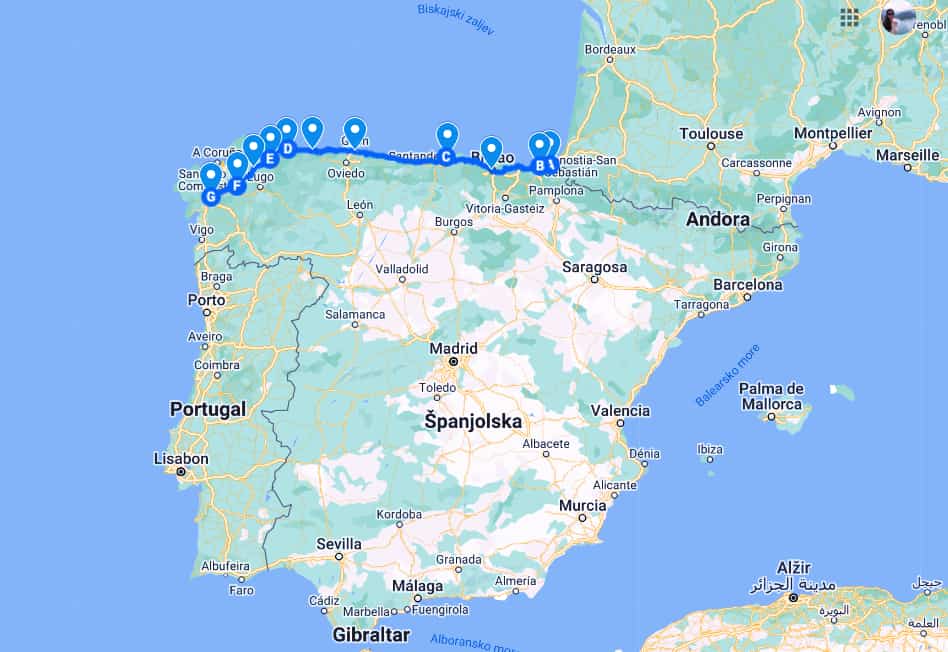
Camino del Norte or the Northern Way of Camino de Santiago goes from Irun via San Sebastian, Bilbao, Santander, and Gijon to Santiago de Compostela.
This Camino de Santiago route was historically taken by pilgrims coming to Santiago de Compostela from Northern Europe.
Camino del Norte is a coastal Santiago de Compostela route. This Camino de Santiago path goes along the coast of northern Spain from the Basque Country via Cantabria, Asturias to inland Galicia. Camino de Santiago del Norte is the Camino de Santiago most scenic route.
Camino del Norte is considered the most beautiful Camino de Santiago route. It is a moderately challenging hiking trail (more difficult than Camino Frances, for instance).
Camino del Norte is a UNESCO World Heritage Site.
Where to fly to start Camino del Norte?
The nearest airport to Irun is Biarritz-Pays Basque Airport. There are direct daily buses from the airport to Irun.
READ MORE: Camino del Norte
Camino del Norte map
2. Camino Frances – the most famous Camino de Santiago route
Starting point: Saint-Jean-Pied-de-Port in the Basque Country, France
Finishing point: Santiago de Compostela in Galicia, Spain
Camino Frances length: 777 km
Camino Frances etapas: 33 stages in total
Camino Frances days: 30-35 days in total
Camino Frances min/max elevation: 249 m / 1512 m
Camino Frances elevation gain/loss: 4849 m /-4089 m
Camino Frances best time to go: April – June, and September – October
Camino Frances type of pilgrims: first-time Camino walkers, history buffs, social butterflies
Percentage of pilgrims who walk Camino Frances: 55 %

Camino Frances or the French Way of Camino de Santiago goes from Saint-Jean-Pied-de-Port via Logroño, Burgos, Leon, Astorga, and Sarria to Santiago de Compostela.
This Camino de Santiago route was historically taken by pilgrims coming to Santiago de Compostela from France.
Camino Frances is a synonym for Camino de Santiago, although it is not the oldest route (the oldest Camino de Santiago route is Camino Primitivo from Oviedo).
Camino Frances is the most famous, most popular, but also the most crowded Camino de Santiago route. It especially gets crowded in Sarria (the last 100 km of the route, a prerequisite for obtaining a Compostela certificate).
Camino Frances also has the best infrastructure (many pilgrims’ hostels, bars, restaurants, shops… along the route) of all of the Camino de Santiago routes. Camino Frances is one of the easiest Camino de Santiago routes to hike. Therefore, this Camino de Santiago de Compostela route is recommended for first-time Camino goers. The Camino de Santiago French Way, is the best Camino route for beginners.
Camino de Santiago Frances is a UNESCO World Heritage site.
Where to fly to start Camino Frances?
Biarritz-Pays Basque Airport is the nearest airport to Saint-Jean-Pied-de-Port.
Fly to Biarritz-Pays Basque Airport and then take a bus from the airport to Saint-Jean-Pied-de-Port.
Camino Frances map

3. Camino Via de La Plata – the epic Camino de Santiago route
Starting point: Seville in Andalucia
Finishing point: Astorga in Leon (in Astorga, the route joins Camino Frances)
Camino Via de La Plata length: 702 km (+ 283 km from Astorga to Santiago via Camino Frances)
Camino Via de La Plata etapas: 37 stages in total
Camino Via de La Plata days: 7 weeks on average
Camino Via de La Plata min/max elevation: 5 m / 1147 m
Camino Via de La Plata elevation gain/loss: 7857 m / – 6995 m
Camino Via de La Plata best time to go: April, May, and October
Camino Via de La Plata type of pilgrims: solitude fans, inner journey seekers, long-distance trails lovers, Camino veterans (pilgrims who already walked one or more Camino routes)
Percentage of pilgrims who walk Via de La Plata: about 3%

Camino Via de La Plata, or the Silver Way, goes from Seville via Merida, Mérida, Cáceres, Salamanca, Zamora, and Ourense to Santiago.
Camino Via de La Plata is one of the longest Camino de Santiago routes (along with Camino Mozarabe).
This Camino de Santiago pilgrimage route is one of the most difficult Camino de Santiago routes (along with Camino Primitivo). In spite of being mostly flat, the route is known for long walking stages, no facilities between the stages, strong summer heat, and lots of solitude.
Where to fly to start Camino Via de La Plata?
Seville International Airport (San Pablo Airport).
Camino Via de La Plata map

4. Camino Sanabres – a historic end of Camino Via de La Plata and Camino Mozárabe
Starting point: Granja de Moreruela in Castilla y Leon
Finishing point: Santiago de Compostela in Galicia
Camino Sanabres length: 234 mi (378 km)
Camino Sanabres etapas: 13 stages in total
Camino Sanabres days: 2 weeks
Camino Sanabres min/max elevation: 55 m/1356 m
Camino Sanabres elevation gain/loss: 7234 m/-7689 m
Camino Sanabres best time to go: April-June, September-October
Camino Sanabres type of pilgrims: crowds-avoiding nature lovers
Percentage of pilgrims who walk Camino Sanabres: less than 0.5%

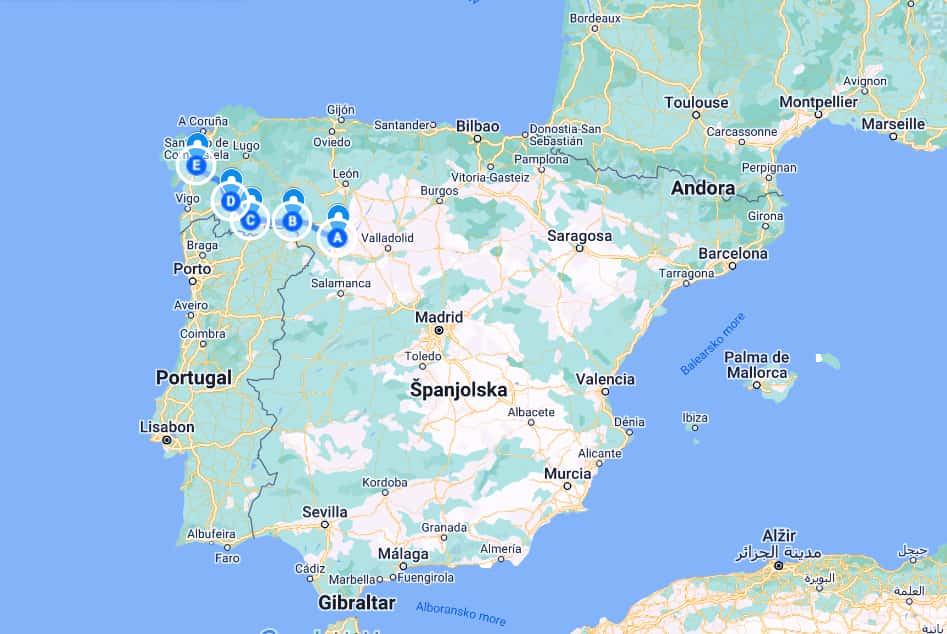
Camino Sanabres or the Sanabres Way goes from Granja de Moreruela via Puebla de Sanabria, Laza, Ourense to Santiago.
Where to fly to start Camino Sanabres?
Salamanca Airport is the nearest airport to Granja de Moreruela. Granja de Moreruela is 1 hour and 20 minutes by bus from Salamanca.
Flying to Madrid-Barajas Airport is also a good option for reaching Granja de Moreruela. Granja de Morerula is also 30 min by bus from Zamora, and Zamora is only 1 h by train from Madrid.
READ MORE: Camino Sanabres
Camino Sanabres map
5. Camino Portuguese Central – a historic Camino de Santiago route
Starting point: Lisboa in Portugal
Finishing point: Santiago de Compostela in Spain
Camino Portuguese Central length: 620 km
Camino Portuguese etapas: 26 stages in total
Camino Portugues days: 25 days on average to walk the entire route
Camino Portuguese min/max elevation: -10 m / 475 m
Camino Portuguese elevation gain/loss: 12149 m/ -11923m
Camino Portuguese best time to go: May, June, and September (wet weather starts in mid-October)
Camino Portuguese type of pilgrims: first-time Camino walkers, social butterflies, foodies
Percentage of pilgrims who walk the Camino Portuguese: about 20%

Camino Portugues Central goes from Lisboa to Coimbra, Porto, Tui, to Santiago.
It is one of the most important historic Camino de Santiago routes, traditionally traveled by pilgrims coming from Portugal. It is one of the most popular Camino de Santiago routes as well.
Where to fly to start the Camino Portuguese Central?
Lisbon International Airport.
Camino Portuguese Central

6. Camino Portuguese da Costa – one of the most beautiful Camino de Santiago routes
Starting point: Porto in Portugal
Finishing point: Santiago de Compostela
Camino Portuguese da Costa length: 260 km
Camino Portuguese da Costa etapas: 13 stages in total
Camino Portugues Coastal days: 2 weeks
Camino Portuguese min/max elevation: 0m / 256 m
Camino Portuguese elevation gain/loss: 4283 m / -4089 m
Camino Portuguese best time to go: May, June, and September (summer is too hot, winter is wet and cold)
Camino Portuguese type of pilgrims: beach lovers, first-time Camino walkers (less crowded than Camino Frances and less physically challenging than Camino del Norte), foodies (Portuguese food, Porto and Albarino wine), social butterflies
Percentage of pilgrims who walk the Portuguese da Costa: about 5%

Camino Portuguese da Costa, Camino Portuguese Coastal, or Camino Portugues de la Costa, goes from Porto via Tui to Santiago.
It belongs to the coastal Camino de Santiago routes, along with Camino del Norte.
The Camino Portuguese Coastal route from Porto to Santiago de Compostela is the second most popular Camino de Santiago route (after Camino Frances).
Where to fly to start the Camino Portuguese da Costa?
Porto International Airport (Francisco Sá Carneiro Airport)
How long is the Camino from Porto to Santiago?
The Camino from Porto to Santiago is 162 mi (260 km).
Camino Portuguese da Costa map

7. Camino Inglese – the shortest Camino de Santiago route
Starting point: Ferrol in Galicia
Finishing point: Santiago de Compostela in Galicia
Camino Inglese length: 115 km
Camino Inglese etapas: 5 etapas from Ferrol (4 etapas from A Coruna)
Camino Inglese days: 5 days
Camino Inglese min/max elevation: 0 m / 461 m
Camino Inglese elevation gain/loss: 2855 m / -2610 m
Camino Inglese best time to go: March – mid-November
Camino Inglese type of pilgrims: to experience Galician culture, for people who have only a short time available for the Camino
Percentage of pilgrims who walk the Camino Ingles: between 4-6%

Camino Inglese or the English Way goes from Ferrol or A Coruna to Santiago.
It is a historical Camino de Santiago route traveled by pilgrims from northern Europe (most notably, England) who arrived by boat to Ferrol or A Coruna in northern Spain, and who from there continued to Santiago by land.
You must start the Camino Ingles in Ferrol (not in A Coruna) to be eligible for a Compostela. A Coruna is only 96 km (less than the prerequisite 100 km from Santiago).
Camino Inglese is the shortest Camino de Santiago route and the easiest Camino de Santiago route.
Where to fly to start the Camino Inglese?
A Coruña International Airport. Daily flights from Paris Orly, London Gatwick, Barcelona, Madrid…
Camino Inglese map

8. Camino Primitivo – the original and the oldest Camino de Santiago route
Starting point: Oviedo in Asturias, Spain
Finishing point: Santiago in Galicia, Spain
Camino Primitivo length: 310 km
Camino Primitivo etapas: 13 etapas in total
Camino Primitivo days: 2 weeks
Camino Primitivo min/max elevation: 40 m / 1216 m
Camino Primitivo elevation gain/loss: 10092 m / – 10076 m
Camino Primitivo best time to go: June – September (to avoid the rain)
Camino Primitivo type of pilgrims: true hikers, nature lovers, history buffs
Percentage of pilgrims who walk Camino Primitivo: about 5 %

Camino Primitivo or the Primitive Way (also known as the Original Way) goes from Oviedo via Lugo and Melide (where the route joins Camino Frances) to Santiago.
It is the oldest Camino route. This was the first Camino de Santiago route ever walked.
Spanish King Alfonso II of Asturias took this Camino route to Santiago on his pilgrimage journey to Santiago for the first time. He was the first person who made a pilgrimage to Santiago.
Camino Primitivo is one of the most beautiful Camino de Santiago routes (along with Camino del Norte) and one of the most difficult Camino de Santiago routes (along with Camino Via de La Plata) because of the many steep ascents and descents.
Camino Primitivo is a UNESCO World Hertiatge Site.
Where to fly to start Camino Primitivo?
Asturias International Airport.
Camino Primitivo map

9. Camino Mozarabe – the longest Camino de Santiago route
Starting point: Malaga, Almeria, or Jaen in Andalusia
Finishing point: Santiago ( it joins Camino Via de la Plata in Merida)
Camino Mozarabe length: 1500 km from Almeria
Camino Mozarabe etapas: 27 etapas until Merida (+28 etapas via Camino Via de La Plata via Ourense)
Camino Mozarabe days: about 10 weeks
Camino Mozarabe best time to go: spring and autumn (avoid the extreme heat in summer)
Camino Mozarabe type of pilgrims: solitude seekers, history buffs (interested in Moorish and Roman history of Spain), foodies (tapas in Granada)
Percentage of pilgrims who walk the Camino Mozarabe: a few hundred pilgrims a year

Camino Mozarabe, or the Mozarabic Way – also called the Mozarabic Caminos, since there are three different starting points (three different starting paths).
The Mozarabic Way can be started in Almeria, Malaga, or Jaen. The paths unite in Cordoba, and from there the Camino Mozarabe route goes to Merida, where the Camino Mozarabe joins the Camino Via de La Plata.
Granada and Cordoba are some of the popular starting points of Camino Mozarabe as well.
Camino Mozarabe is the longest Camino de Santiago route.
Where to fly to start the Camino Mozarabe?
Malaga-Costa del Sol International Airport, or Almería International Airport
Camino Mozarabe map

10. Camino Invierno – the historic Templar knights Camino de Santiago route
Starting point: Ponferrada
Finishing point: Santiago de Compostela
Camino Invierno length: 263 km
Camino Invierno etapas: 10 stages in total (the last 2 stages are of Via de La Plata Sanabres)
Camino Invierno days: 10 days in total
Camino Invierno best time to go: spring, summer
Camino Invierno type of pilgrims: solitude fans, nature lovers, off-the-beaten-track Camino enthusiasts
Percentage of pilgrims who walk Camino Invierno: about 0,5 %

Camino Invierno, or the Winter Way, goes from Ponferrada via Lalin (where the Camino Invierno route joins the Via de la Plata Sanabres route) to Santiago de Compostela
The Winter Way is a variant of Camino Frances used by medieval pilgrims to bypass snow-covered O Cebreiro in winter. Historically, this Camino de Santiago route was related to Templar knights.
Camino Inverno is walkable all year round, but still, spring and summer are the most preferred seasons for lush green landscapes and pleasant temperatures.
Where to fly to start Camino Invierno?
Santiago-Rosalía de Castro Airport in Santiago de Compostela. And from Santiago, take a bus or train to Ponferrada.
Camino Inverno map

11. Camino a Fisterra – the historic end of the Camino de Santiago trail
Starting point: Santiago de Compostela in Galicia
Finishing point: Fisterra in Galicia
Camino a Fisterra length: 90.8 km
Camino a Fisterra etapas: 4 etapas
Camino Fisterra days: 3-4 days in total
Camino a Fisterra min/max elevation: 4m /477 m
Camino a Fisterra elevation gain/loss: 2227 m / -2368 m
Camino a Fisterra best time to go: April-June, September-October.
Camino a Fisterra type of pilgrim: anyone who wants to hike to ‘the End of the World’
Percentage of pilgrims who walk the Camino a Fisterra: 1 % of all pilgrims who reach Santiago

Camino a Finisterre is the final leg of Camino de Santiago that starts in Santiago de Compostela.
Finisterre Lighthouse is the historical end of the Camino de Santiago pilgrimage route in Spain.
Where to fly to start the Camino a Fisterra?
Santiago-Rosalía de Castro Airport in Santiago de Compostela
Camino a Fisterra map

12. Camino a Muxia – the alternative end of Camino de Santiago
Starting point: Santiago de Compostela in Galicia
Finishing point: Muxia in Galicia
Camino a Muxia length: 88 km
Camino a Muxia etapas: 4 etapas in total
Camino Muxia days: 3-4 days in total
Camino a Muxia min/max elevation: 5 m /477 m
Camino a Muxia elevation gain/loss: 2239 m / -2480 m
Camino a Muxia best time to go: April-June, September-October.
Camino a Muxia type of pilgrim: anyone who wants to hike to the end place in The Way movie
Percentage of pilgrims who walk the Camino a Fisterra: 1 % of all pilgrims who reach Santiago

Muxia is an alternative end to Finisterre.
Muxia is the end place in The Way movie.
Some pilgrims prefer Muxia, and some Finisterre as teh place to finish their Camino de Santiago pilgrimage.
Where to fly to start the Camino a Muxia?
Santiago-Rosalía de Castro Airport in Santiago de Compostela
Camino Muxia map

Q&A
What is the route of the Camino de Santiago?
Contrary to common belief, there is no single Camino de Santiago route. The Camino de Santiago is a network of routes created by pilgrims traveling to Santiago de Compostela from various parts of the world.
The most popular Camino de Santiago route is Camino Frances (the French Way), which begins in Saint-Jean-Pied-de-Port in the Basque Country in France.
Some of the most popular Camino de Santiago routes are Camino Portugues (the Portugues Way) which starts in Lisbon in Portugal, Camino del Norte (the Northern Way) which begins in Irun in Spanish Basque Country, Camino Inglese (the English Way) which starts in Ferrol in Galicia, Camino Primitivo (the Primitive Way) which begins in Oviedo in Asturias in Spain, and Via de La Plata (the Silver Way) which starts in Seville in Andalusia in Spain.
What is the best route to walk the Camino de Santiago?
The 5-day-long Camino de Santiago Inglese (the English Way) is the shortest and easiest Camino de Santiago route.
The famous Camino de Santiago Frances (the French Way) is the most popular Camino de Santiago route and one of the least demanding Camino de Santiago routes. It is recommended for first-time Camino goers.
Popular Camino de Santiago Portugues (the Portuguese Way) from Lisbon is one of the not-so-difficult Camino de Santiago routes, which is also recommended for first-time Camino pilgrims.
Coastal Camino de Santiago del Norte (the Northern Way), which follows the coast of Northern Spain, is the most beautiful Camino de Santiago route and one of the most difficult Camino routes. It is recommended for nature lovers and foodies.
Hilly Camino de Santiago Primitivo (the Primitive Way) is recommended for nature lovers and true hikers.
Challenging Camino Via de La Plata (the Silver Way) is recommended for solitude seekers and history buffs.
Which Camino route is the most beautiful?
The most beautiful Camino route is arguably Camino del Norte. It is a coastal Camino route that follows the coast of northern Spain. Camino del Norte goes from the Basque Country, across Cantabria and Asturias to Galicia. Camino de Santiago del Norte is the most scenic route that goes across long sandy beaches, breathtaking sea cliffs, pristine green hills, vast vineyards, charming fishing villages, pretty tourist seaside towns, picturesque medieval towns, and gorgeous cities (like San Sebastian and Bilbao).
Which Camino route is the easiest?
The Camino Inglese is the Camino de Santiago easiest route. It takes only 5 days to hike the Camino Inglese. The Camino Ingelse goes only across Galicia. It starts in the city of Ferrol on the northern coast of Galicia.
What is the shortest Camino route?
The Camino Inglese (the English Way) is the shortest Camino route. The Camino Inglese is only 115 km long, and it takes only 5 days to walk the entire route.
What is the most popular Camino route?
The Camino Frances (the French Way) is the most popular Camino route. 55% of pilgrims who walk the Camino de Santiago choose Camino Frances, which starts in Saint-Jean-Pied-de-Port. The second most popular Camino route is Camino Portuguese Central, which starts in Lisbon. 20% of Camino de Santiago pilgrims walk the Camino Portuguese Central.
Which is the most scenic Camino route?
Camino del Norte (the Northern Way) is the most scenic Camino route. Camino del Norte follows the green northern coast of Spain. The Camino del Norte route goes across long sandy beaches, breathtaking sea cliffs, pristine green hills, vast vineyards, charming fishing villages, pretty tourist seaside towns, picturesque medieval towns, and gorgeous cities (like San Sebastian and Bilbao).
What is the hardest Camino route?
While the hilly Camino Primitivo is a physically challenging Camino route, the hardest Camino route is Via de la Plata. Via de la Plata is known for its long-distance etapas (stages) with no trees to give any shade and protection from the sun and no hospitality facilities. There were some pilgrims’ deaths on the Via de la Plata route in the past because of the strong sun in July and August. Pilgrims on Via de la Plata need to bear up with strong sun, carry lots of water along, and be ready for lots of solitude. Vis de la Plata is considered the most spiritual Camino route as there are not many ‘distractions’ (there are not many people, not many facilities) along the way.


